 Kapti
Internal project Healthcare
Triage patient messages with AI, without taking the decision away from clinicians
2,000 messages a week, urgent cases buried among appointment requests. AI-assisted triage, explained and always validated by a human.
- Sector
- Healthcare
- Typical engagement
- 5 weeks
- Indicative budget
- From €24,500 excl. VAT
- Proposed team
- 4 leads from the collective
- Services
- AI Product Sprint · AI Screen Audit (AI Act)
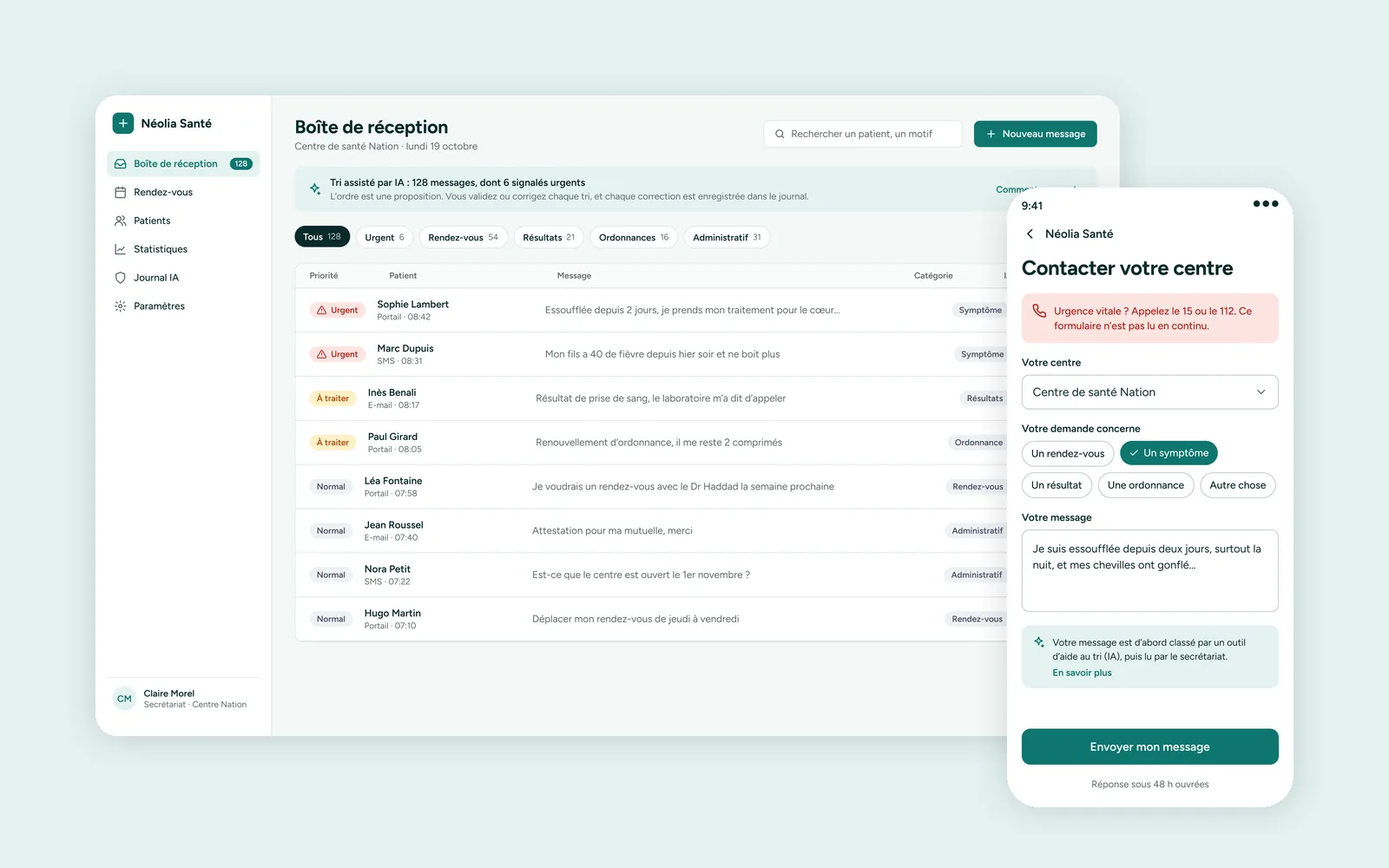
Internal project, carried out by collective members to explore the healthcare sector. This is not a client engagement: “Néolia Santé” is a demo brand.
Context
The need we imagined, based on what we hear in the sector:
Our front desks receive around 2,000 messages a week via the patient portal, email and SMS. Urgent requests get lost among appointment requests and administrative questions. Management wants AI, but our doctors refuse a tool that would decide for them.
Typical client: A platform already central to communication between patients and clinicians, used every day by health center front desks.
The challenge
- 1
Decide nothing on clinicians’ behalf
The AI suggests a processing order. The medical secretary or doctor validates or corrects it, and every correction is logged.
- 2
Health data
Hosted by an HDS-certified provider (French health data hosting), messages anonymized for training and testing, no data sent to any consumer service.
- 3
AI Act and transparency
Patients know that a triage assistance tool is in use. Clinicians see why a message is flagged as urgent and with what confidence level.
The engagement we would run
Typical 5-week engagement
Here’s how we would run this engagement for a real client. The screens and demo below were produced during the internal project.
- 1
Research · Week 1
Observation of 3 front desks, 12 interviews (medical secretaries, doctors, 5 patients), analysis of 300 anonymized messages. Goal: define request categories and the list of urgency signals with the lead physician.
- 2
Design · Week 2
Inbox sorted by priority, message summary with key passages highlighted, visible confidence level, and a “Why this triage?” button.
- 3
Development and testing · Week 3
Working version connected to an HDS-hosted language model and 300 anonymized messages, tested with 5 medical secretaries in real conditions.
- 4
AI Act audit · Weeks 4 and 5
Review of patient-facing notices, the correction log and human oversight. Prioritized remediation plan and final mockups.
The team we would bring in
4 leads, one role each

Vincent Pedemonte
Engagement lead

Romain Peltier
Research and product design

Meril Banzouzi
Back-end and AI development

João Da Silva Marly
Front-end and design system lead
The screens
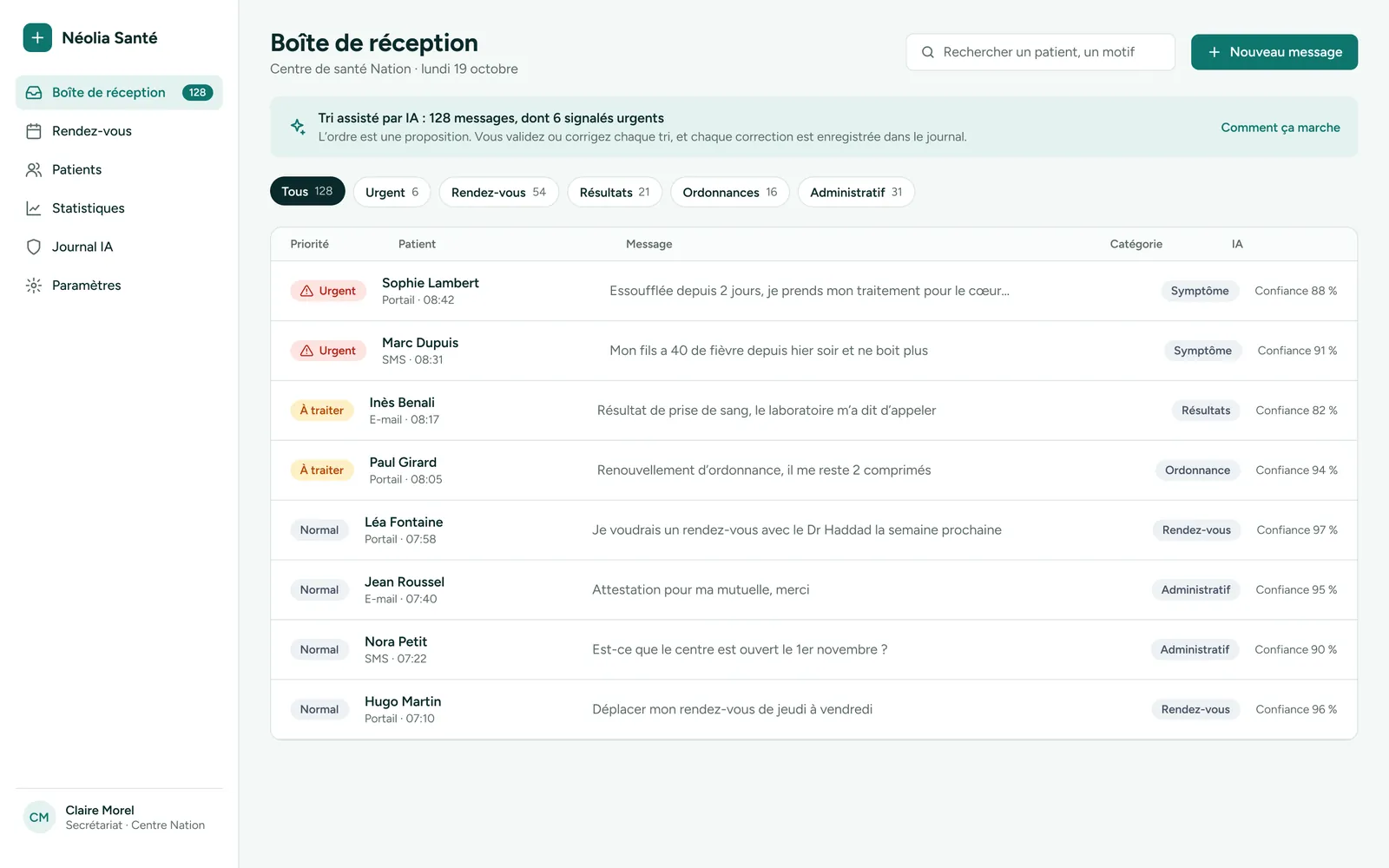
Inbox sorted by priority. Urgent messages rise to the top with the detected reason and confidence level. The medical secretary stays in control of the order.
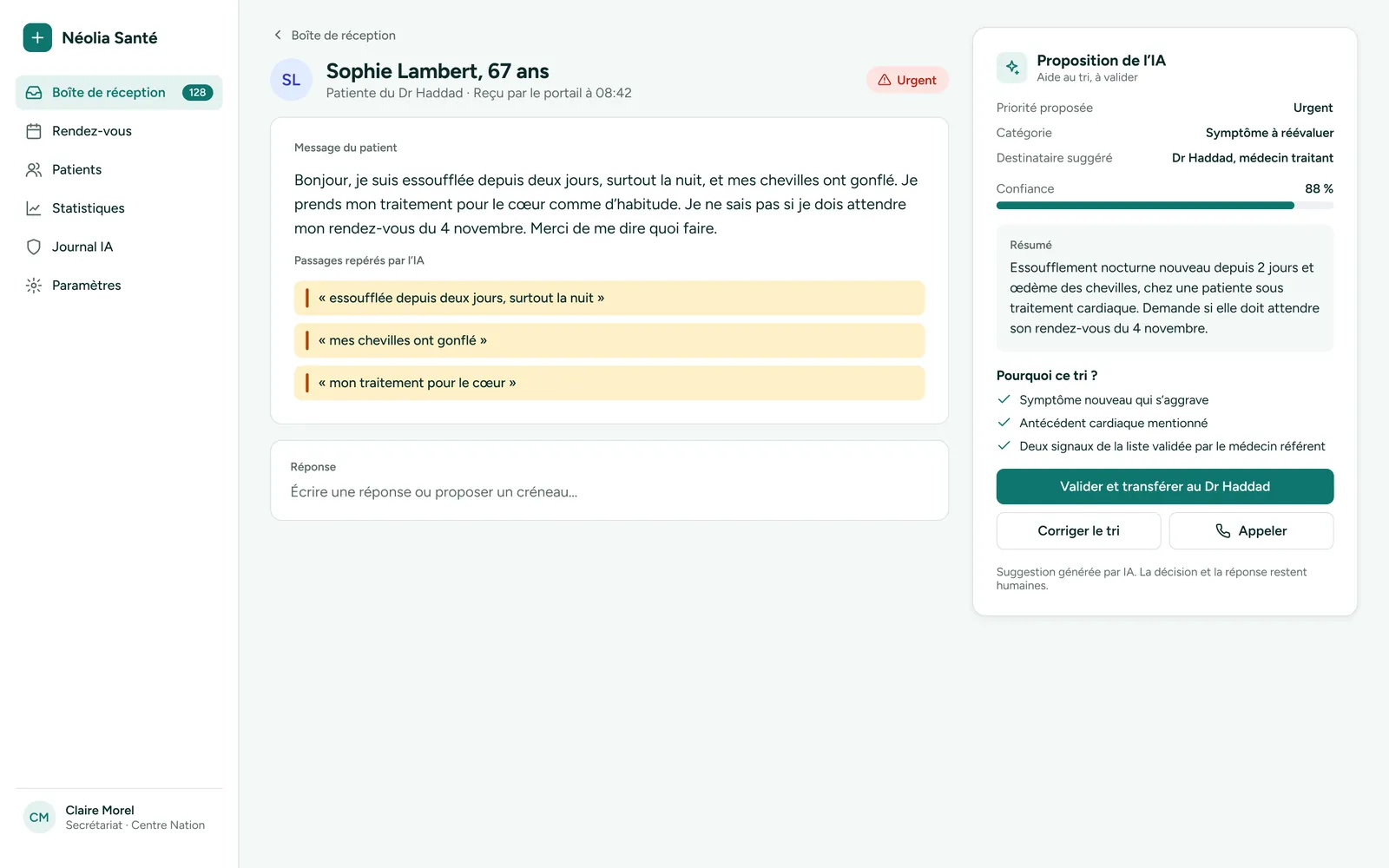
Open message with summary and explanation. Three-line summary, key passages highlighted, suggested category, and one-click correction.
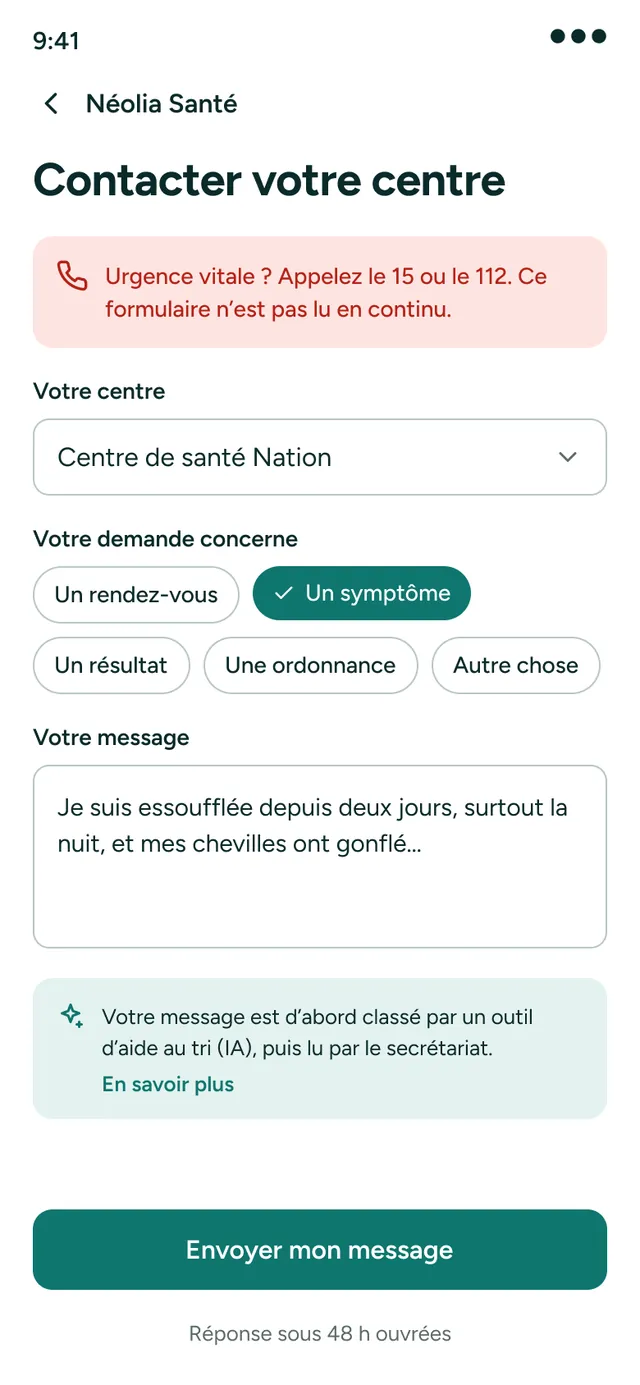
Patient side, on mobile. The contact form clearly states that AI assists with triage and reminds patients to call emergency services (15 in France) in a life-threatening emergency.
Interactive demo
You work at a health center front desk
A patient writes to the center. The assistant suggests a priority and explains why. You make the call.
Your turn
- 1Keep the message or pick an example
- 2Click “Suggest triage” and read the reason
- 3Validate, or correct: the correction is logged
Try triaging a message
Demo data.
Decision log
Target outcomes
- Time to handle an urgent message · Goal: under 2 hours
- Share of triages corrected by medical secretaries · Tracked weekly to improve the model
- Front desk satisfaction · Measured before and after, out of 10
What the client would receive
- Research synthesis and validated categories
- Mockups of the inbox, message and patient screen
- HDS-hosted working version
- AI Act audit report and remediation plan
- Costed go / no-go recommendation